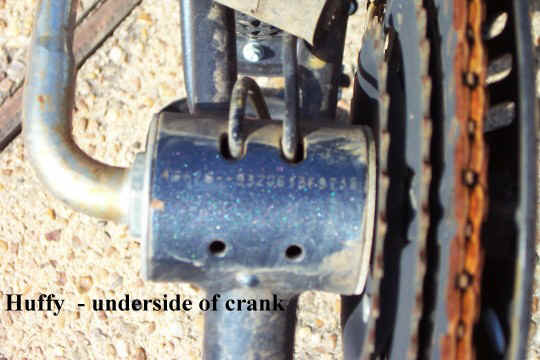
Huffy Bmx Bike Serial Numbers

1990 Slingshot December 2nd ”The 90’s”. Wow, where has the time gone? Some of the bikes and technology that we’re going to show off will seem like they’re still current, but most of it has been gathering dust for twenty years now. Mountain bike suspension, hydraulic braking and elaborate new shifting systems were invented in the ‘90’s. New materials came into play, aerodynamics became a design element, and Paul worked on the international racing circuit in the ‘90’s (so there are lots of stories to tell). We’ll have a couple of special guests.
Logan Owen, who was born in the ‘90’s, is now a racer with the Cannondale-Drapac team. Kiel Reijnen, who learned to ride a bike in the ‘90’s, races for Trek-Segafredo. They should have some great bike racing stories. Built in honor of Hetchins' finest work I know, this bike is confusing. The label seems to make it too new to belong in a museum, and the components and construction style would suggest that this is a really old bike.
Seems like we’re trying to pull a fast one on you. We’ll try to explain. The most similar analogy to this bike that we can think of is the retro-looking record players available now that have jacks to hook up to your iPhone.
Or maybe it’s like an old car that got hot-rodded with a modern engine and suspension. Unlike a hot rod, this bike has the old engine and suspension but a new body. It’s a remake of a more “historic” bike, and a true classic itself. Imagine how long it took to file and polish these Built in 1999 to commemorate the new millennium, Hetchins offered bike junkies like our friend Jeff a chance to ride around on a piece of history by bringing back one of their oldest and most ornate lug sets. The steel tubing joining those lugs is thinner and lighter weight than what was used in the ’30′s, but the ride quality is similar. Jeff commissioned this bike to be a replica of the Hetchins that star athlete Tony Merkens rode at the 1937 Crystal Palace six-day race. The knob damps the steering response In 1941, Alf Letourneur piloted his Wastyn-made Paramount to a motor-paced speed of 108.92mph, breaking Frank Bartell’s six year old record in the process.
This sturdy relic has some interesting features. Up on the head lug we have a knob that tightens down on the steerer tube of the fork, damping the steering response. Also unusual for the time are the rear stays that make up the back of the bike, which are built of triangular shaped tubing. Lastly, the top tube has a slight downward slope which positions the racer in a low aerodynamic crouch when gripping the bars.
Become a Pro Member. BMX Bikes / G.
Al Sellinger’s Brennan We’re the first to admit that there are a lot of plain-looking old track bikes in the collection. If you look carefully, however, you’ll see some real history rolling around on wooden rims. This is Al Sellinger’s Brennan track bike. Al was a member of the U.S. Olympic Team at the 1936 Berlin Games.
The bike itself looks like a lot of pre-war racing machines. There are a few details in common with other Brennan bikes in the collection, but there are also details that make this one stand out.
The seat stays and chain stays are much larger in diameter and thicker-walled than any of our other bikes. It’s a sprinter’s rig. Al must have had quite a bit of horsepower to require such stiff construction for the back end of his bike. Brennan front end Al was the U.S. Amateur sprint champion in 1935, a distinction that nearly guaranteed his inclusion on the ’36 Olympic roster.
Al raced with distinction at the “Nazi Games”, finishing in 9th place in the men’s sprint competition (won by Germany’s Toni Merkins) and 10th in the 1000 meter individual time trial (which was won by the Netherland’s Arie Van Vliet). In the tandem sprint event Al and his partner William Logan made it into the quarter finals but were beaten to the line by the Italian team of Carlo Legutti and Bruno Loatti. Frank Miserndino’s Debacco Special Racer A great old machine, and one of jeff’s most recent acquisitions, this bike was built in the northern New Jersey work shop of the DeBacco brothers Angelo and Joe. This “Special Racer” model was specially built for a racer named Frank Miserndino.
Frank was apparently a road guy, so the bike mainly saw the roads of North Jersey and the surrounds. Frank’s name has come up more than a few times while researching the ’30′s East Coast racing scene and Frank frequented the shops owned by both Joe Kopsky and John Brennan.
Ted Bendi's 1925 Copper-plated Appelhans This beauty was created by Willy Appelhans, an accomplished bike builder in the Bronx, New York. The bike was originally owned by Ted Bendi, a successful track racer and the president of the Union Sportive Italiano cycling club in the twenties and thirties. Standard track geometry of the era meant that the bike was comfortable for long hours in the saddle, as well as having a nice “snap” for the sprints. Instead of enamel paint or even chrome plating, Ted asked for copper. It was a real eye magnet.
Imagine this bike, seen from the stands, gleaming copper in a sea of painted bikes. 1939 Malvern Star A great bike from the land down under. This is a Malvern Star. To be specific, it’s a Two-Star model from the Australian bicycle company Malvern Star. The bike is a mid-level model that was meant to be fast and tough but not as pretty or as light as the flagship Five-Star model. I don’t know, this one looks pretty spectacular to us. Like the ’48 Malvern Star and the 1920′s Arrow Racer that we have in the collection, this one sports an impressive finish.
The beautifully painted frame details appear to be the handiwork of Ken Dickie. Ken was an artist who lived in Melbourne and applied his brushwork to some of the coolest bicycles we have ever seen anywhere. Ken worked with a steady hand, a great eye for details and a tremendous amount of patience. Modern shifting, pre war The shifting system is cutting edge technology from 1938. A Cyclo “Oppy” twin wire. Using two cables, the top-tube mounted lever would pull the derailleur, which dragged the chain sideways across the multiple freewheel cogs that were fitted to the rear wheel. The Oppy, which was named after Hubert Opperman, was an improvement over the popular Cyclo standard derailleur of a few years earlier.
The Oppy replaced the standard’s long chain tension spring with a coiled spring around the derailleur piston. It looks like we have a 3-speed freewheel mounted on the Malvern, so with a 15 to 17 tooth spread you would have had it easy compared to your single-speed riding partners. 1937 Claud Butler Tour d’Angleterre Claud Butler made some truly fantastic bicycles, but this is our favorite. There are so many great design elements on this bike that it’s hard to know where to start.
There are oil ports all over the bike. There’s an integrated chain lube reservoir. The shifting system is amazing. The paint is beautiful.
The tubing must be awesome because the whole bike is really light. Oh, and the name! The Tour d’Angleterre (Tour of England) was probably a tribute to the bikes that were used in the Tour de France that summer of 1937. The frame angles on this bike are much steeper than was common in the 1930′s, and the bike rides similarly to modern machines. Fill the reservoir up with chain lube here Reynolds 531 frame tubing made this a surprisingly light (23 pounds with fenders) and responsive bike.
In two spots around the head tube and one spot on top of the bottom bracket shell there are ports where you can add oil to the bearings housed within. On the seat tube there is a port that can hold about 4 ounces of chain oil. At the bottom of this reservoir there is a spigot that can be rotated to drip lubricant right onto the the chain.
You could even operate this feature as you pedaled! That little fork moves the chain side to side The three-speed shifter on the bike is an “Osgear”, fully known as the Constrictor Osgear Super Champion. 1937 marked the first year that bikes with gear changers like the Super Champion were allowed in the Tour de France. The name ‘Osgear’ was a take on the name Oscar Egg, the designer (and a famous Swiss-French cyclist from the era). The Osgear was light yet sturdy, and fairly simple to operate.
Fitted to the chainstay is a cable operated guide arm that moves the chain right or left across the three sprockets. The tensioning arm near the crankset takes up the slack of the chain, and has a guide-loop of metal on the pulley to keep the chain from coming off. Aluminum chain guard and fenders If the sales pitch was successful, that boy would have quite a prize. This Iver Johnson was special.
It had aluminum fenders and a chainguard to protect clothing from road grime. There was a coaster brake hub on the back wheel, so you could enjoy speeding downhills (unlike your friends on their fixed-gear bikes) and still stop with confidence. The wheels looked super fast.
They were painted to resemble the wooden rims on an ultra-light racing machine, but were actually sturdy (and less expensive) metal rims. Adam Brenner's Bengal Special Racer Sure, this bike is a little rough, but let’s see how good you look in a hundred years. This Special Racer was originally purchased from the Progressive Cycle & Auto Supply Company of New York City by a local area man named Adam Brenner.
The Bengal was one of Progressive Cycle’s sporting models from the teens or early twenties (judging from the frame angles and tubing sizes) and was probably built by Columbia or another large bicycle manufacturer of the time. In researching this bike, we discovered that the “Bengal Special Racer” model name was later applied to Progressive Cycle’s balloon tire boys’ bikes following World War II. 1907 Racycle There are a lot of names here so lets see This is the Pace Maker model RaCycle, and RaCycles were made by the Miami Cycle and Manufacturing company of Middleton, Ohio.
Bikes like this one followed high-wheelers onto the cobbled streets of early 1900′s America. With newly invented roller chain and pneumatic tires, this would have been a luxuriously smooth ride compared to a Penny-Farthing. One of the selling points of the Pace Maker was the massive front chainring (equivalent to a modern 84-tooth ring) that was meant to attract attention and suggest higher speed (but the big ring was actually offset by a big back cog that ended up producing a comfortable gear ratio). Racycle advertisement Check out the old ad that we found for RaCycle bikes. The copy in old advertising and press releases like this one was so earnest.
According to the manufacturer, a 1904 Worlds Fair jury “consisting of the ablest consulting and manufacturing engineers in Europe and America, were unanimous in their decision that the Racycle was the most perfectly constructed, easiest running bicycle in the world.” However they were judged, early “safety” bicycles like this one really brought inexpensive personal transportation to the masses. They connected people with jobs and schools, connected rural areas of the country with cities, connected extended families (and liberated family members from one another). This bike was originally owned by Harry Nettleton of Red Wing, Minnesota. Harry raised the original $16.50 purchase price by collecting clam shells from the Minnesota river and selling them to a local button factory. By the way, if you take a look at the Iver Johnson Truss-bridge bike from the same era, you’ll note that the RaCycle was about a third of the price of the Iver Johnson.
1934 Caminade Caminargent This stunning aluminum racing bike was built by Caminade of Paris at a time before aluminum TIG welding had been developed. Instead of welded joints like we know today, Caminade used socketed joints and glued and pegged each tube into place. Over seventy years have passed by, and this bike is still rideable (although a bit creaky). The tubing is heptagon shaped, and in places it is drilled out to save weight! A high-tech wonder from the thirties that weighs less than most modern bikes at just 15 pounds. Caminargent head tube The three-speed shifter on the bike is an “Osgear”, fully known as the Constrictor Osgear Super Champion. The name ‘Osgear’ was a take on the name Oscar Egg, the designer (and a famous Swiss-French cyclist from the era).
The Osgear was light yet sturdy, and fairly simple to operate. Fitted to the chainstay is a cable operated guide arm that moves the chain right or left across the three sprockets. The tensioning arm near the crankset takes up the slack of the chain, and has a guide-loop of metal on the pulley to keep the chain from coming off. Tony Soberaski’s Sun Club Racer Despite the name, it’s not really a racer.
It’s a Sun “Club” model. What became the Sun Cycle company was founded by James Parkes & Son in 1885. Initially a brass foundry, the company started manufacturing bicycle frames and parts in 1898.
In 1907 the company changed its name to The Sun Cycle & Fittings Company and began making and selling its own line of bicycles. The ’20′s through the ’40′s were good years for the brand, and bikes like this club model were quite popular. In the late ’50′s, a lot of small British bike labels consolidated through attrition and mergers, and Sun Cycles eventually melted into the Raleigh brand. Extra clothes, spare parts, and some food. Randonneurs are expected to be self-sufficient, so the bikes have to be able to carry extra gear. The weather can change dramatically over these long events, so fenders and lights are common accessories.
Guys in the Seattle Randonneurs Club would still use this bike today. The distances involved in brevets favors equipment that is “tried and true”. Nothing more tried (and maybe still true) than 80 year old parts. Today, these guys would call the Cyclo Standard shifter “more reliable” than any derailleur with a high-tech return spring.
Four gears seems just about right! Modern derailleur systems with 20 or more gear ratios would be derided as “overly complex”. 1915 Crown bicycle We’re making an educated guess on the date here, but we’re pretty close.
This Crown was born about a hundred years ago, and it’s held up really well. Built by the Great Western Manufacturing Company of LaPorte, Indiana, the bike showcases some nice artistic touches and fine manufacturing skill. Great Western became a bike company in 1898 when four small builders combined their labor and capital into one. The merger made a large and successful bike company that continued until about 1920. 1886 American Star bicycle Star bicycles were originally manufactured by the Smith Machine Company in Smithville, New Jersey. The American Star was designed with the smaller wheel in the front to avoid the tendency found in other high wheelers (that have smaller trailing wheels) to pitch forward.
The Star pedals ratchet up and down around a flywheel, a design that also incorporates two different gear options. While a Star rider was less likely to pitch over the front wheel when encountering a road obstacle, care had to be taken not to fall over backward. Franz Duelberg’s 1927 Boogmans Stayer Motorpace bikes, or “Stayers” are pretty rare.
It is pretty unusual to find one of these on the west coast of America, and really weird that we have a half-dozen of them on Bainbridge Island. We have a story about that. First, some background Stayers like this are made for an esoteric type of bicycle track racing that involves drafting behind a Derny or a motorcycle (check out the photos for an idea). The reversed fork keeps the bike stable at the extremely high speeds associated with motor paced events.
This particular stayer was originally built by the Belgian Boogmans bike company for a German track cyclist named Franz Duelberg. Boogmans had a reputation for making some of the best racing bikes of the era. A motor-paced track race The bike was displayed on a wall in her house on Kallgren avenue until the day of the Nisqually earthquake, when it fell off the wall and the wooden rims got damaged. Sully brought the bike down Kallgren to her neighbor Jeff (who happened to own Classic Cycle at the time) to see if he could repair it. Not only did Jeff have the 80-year-old-odd-sized rims with which to fix the bike, he had a matching Boogmans stayer built in the same year!
Quite a trip for an old bike to make to meet up with one of its dozen-or-so sibblings! Really neat chain stays The cyclist who originally raced the bike? Duelberg was fast. In his rookie season Franz partnered with another new racer, a young Jimmy Walthour jr., and together the duo won the 1928 six-day races in Detroit and Chicago. In November 1936, a Melborne newspaper exclaimed “Duelberg Brilliant!
One of the finest exhibitions of motor-paced bike racing that has been seen in Melbourne was given by the German Franz Duelberg at the third board track cycling meeting at the Exhibition on Saturday night.” So this bike made a trip to Australia too. 1887 Columbia Expert Is it any wonder that the high-wheel bicycle became such an icon? Beautiful machines like this one have represented both progress and antiquity over the past 125 years. Penny-farthings are an easily recognizable symbol for “bicycle”. A lot of bike shop signs (probably spelled “Bicycle Shoppe”) feature high wheelers. Store advertisements, historic town districts, and corporate logos often use them to signify antiquity or historical heritage.
Microsoft’s home of Redmond Washington identifies itself with a Penny Farthing on the city signage. That creepy village in The Prisoner T.V. Series had these bikes all over the place. The pedals could be moved to fit the rider better To mount one of these, you used the little step just above the rear wheel and hopped up onto the saddle.
The large wheel and strong gyroscopic effect actually made these pretty easy to ride around on, as long as you paid attention. To stop, you would slow the pedals with your feet while pressing the spoon brake into the tire. High speeds and descents were pretty scary.
With your center of mass high above the front wheel, an unexpected pothole could easily send you over the handlebars. Note the step just above the wheel. Why ride a high-wheel bike? Well, at the time it was simpler, lighter, and faster than bikes with smaller same-size wheels. The large wheel rode over cobblestones and road bumps more smoothly than smaller wheels (remember, in the 1800′s hard rubber or metal “tires” had no air in them). Velocipedes of all sizes were direct-drive in this era, so the only way to make the bike faster was to make the driving wheel larger (you were only limited by a rider’s leg length). 1935 Archie Weaver tricycle Arthur “Archie” Weaver was a master craftsman.
The Weaver cycle shop on Leyton High street was a magnet for English bicycle racers in the 1920′s and ’30′s. Tricycle racers too, apparently.
A bit of a bike nut, err, trike nut, Mr. Weaver built this magnificent racing tricycle for himself. The rear differential was machined in the Weaver shop, and the fixed gear drives the left side wheel. Riding on the left side of a crowned road would be really tough without a differential or with the right wheel propelling the trike.
Archie’s friend in the Glendene cycling club, C.J. Drayton, set the 200 mile time trial record on this machine in 1935. 200 miles in 11 hours and 46 minutes! Archie Weaver frame detail The head badge states “The Glade”, which refers to the nearby Glendene Cycling Club, a club supported by Weaver’s shop and named after a favorite spot in Wales. The 32nd milestone on the badge most likely denotes a meeting place (or mid-ride sprint) for club members as they ride on the A11 road leading out of London. That milestone is still in place today. We just learned an interesting note about Mr.
His grand-nephew Ben informed us that Archie was also an accomplished model and trophy maker. Among a varied array of cool creations, Archie fashioned the eyeballs for the puppets that starred in the “Thunderbirds” television show. The seat tube is dimpled so the wheel can be pulled in closer Hyram “Harry” Hetchins and his partner Jack Denny developed quite a following at their North London bike shop. Curved tubes and ornate lugwork were only part of their musically inspired creations. The creased “Six Day” seat tube provided room for the rear wheel to be tucked farther forward, making a shorter wheelbase for quicker handling. Like the curvy tubing (which was originally meant to make unlabeled Hetchins racing bikes identifiable to spectators) the dimpled tube was originally done for track racing star Tony Merkins, and became a regular feature on the Hetchins bikes sold to the general public.
1947 Conloy Osgear derailleur Does the rear derailleur look a little advanced for the 1930′s? It should. It’s a Conloy Osgear, and it came out in ’47, but it looks and works really neat, and would have been the kind of thing a Hetchins owner would have upgraded on a 10 year old bike. The Conloy Osgear rear derailleur utilized a modern parallelogram design and a single shift wire.
Unfortunately it only had a single pulley, so the total gear difference could only be about six teeth. The shift cable runs up and along the top tube, which puts the lever in a nice convenient spot. 1930′s Emil Wastyn This bright old bike was originally owned and raced by Ed “Killian” Williams. An active cyclist in the ’30′s, Ed was a successful racer who earned his nickname from a blistering sprinting style that mimicked the great track racer Gustav Killian.
Look closely. Interesting features will poke out on this otherwise simple chrome bike.
Check out the head tube lugs that wrap around the steerer tubes like chrome fingers, holding the tube in place. There’s the drooping handlebar stem up front and the drilled-out crank arms down low.
Those BSA cranks were drilled out after the fact No factory warranty on those. 1916 Mead Ranger Imagine that you were born a bicycle. Born a Mead Ranger bicycle in 1916. Born in Chicago, but ready to ride anywhere! You grew up rolling down cobbled streets and dirt roads, taking little trips and having a good time. Road racing through the roaring ’20′s.
All of the miles you covered in the 1930′s! Everybody was suffering from “depression” except you.
You were out going places on new roads and were meeting new bikes from all over. World War Two was a busy time, with gas rationing going on you did your duty and kept everyone moving. Hung up in the back of your owner’s garage in the 1950′s, you thought that your days of adventure were over.
You would spend the next few decades hanging from the rafters, trading stories with an old wooden canoe. You kids and your stickers! Get a real head tube badge! In the ’80′s your family decided to sell your garage (along with their house) and you were given to a guy named Jeff who seemed to like your kind. At Jeff’s Classic Cycle shop you met a bunch of old timers like yourself, and you talked about the old days The cobblestones, racing around, snaring dresses and trouser legs with your chain It was a good retirement.
Then one day you were roughly woken from a nap and brought into the work room at Classic Cycle. You were being tuned! Fresh grease? That hadn’t happened in years! 70 pounds of pressure in your tires?
Hey, what’s going on? You are a display bike now, not a rider. Before you knew what happened you were being crammed into a cardboard box and loaded onto a UPS truck. This is no way to be treated! Unpacked and reassembled in Colorado, this young fella starts riding around on you. Is the air here a bit thin?
First ten miles, then thirty. You haven’t rolled this far in decades!
Look at those hills! Grand Junction, Colorado? Isn’t Palm Springs a better place to spend your golden years? You and that crazy fella Tristan racin’ like in the old days at L’Eroica Before the week is up you find yourself at the start of what looks like a race, no doubt about it. There are some old timers like yourself, along with some of those young upstarts like those you met back in the Classic Cycle storage room. They all look excited and freshly overhauled, some with new tires even.
Someone fires a pistol and that young fella starts you rolling. He doesn’t stop. Ten miles on fresh pavement. Twenty miles down a long descent. At thirty miles there was a bit of gravel, just like in the old days. You keep going, even through a rain storm. Through hail.
Your coaster brake hasn’t ached this badly, ever. On a long stretch of gravel after seventy miles you start to loose your dentures (er, axle nuts). That crazy young fella catches them just in time and tightens them back on. He must be slow, doesn’t know about those new bikes with quick releases (and gears and disc brakes)!
You think longingly about that spot above the Harbour Pub bar where you sat last summer, with people lifting their drinks to you and admiring your “lines”. The ride doesn’t stop.
After ninety miles that crazy fella slowed you down to a more sensible pace, but he didn’t stop. One hundred miles rolled under your tires that day, one for each year of your long life. Your springs haven’t been ridden that hard since the War. Finally all of the nonsense comes to an end, and the young fella stops pedalling and gets off your aching saddle. One of the other bikes tells you that you just got second place at some old-timers race called L’Eroica! Well how ’bout that? That’s really something.
Ninety-seven years old and you can still give ‘em hell! Heck, you think, wait until I tell all of the new bikes back at Classic Cycle. All smug with their carbon fiber and high technology. Why, let’s see some of those new guys try this in a hundred years. Bill Honeman’s 1932 Brennan racing bike Tough old racing steel. This racing bike saw hard mile after mile in its years of service.
Raced, crashed, trained on and played with by a cyclist named Bill Honeman, it served with distinction. John “Pop” Brennan built bikes like this one in his Newark, NJ workshop for many of the best racers of the day. Bill “Willie” Honeman raced sucessfully for years and was the junior national champion in 1924, and national champion as a professional in 1934, 1935, and 1936. Original blueprint for one of Honeman’s Brennans Willie broke a lot of ground for other cyclists to follow. He was the first American to wear a stars-and-stripes jersey as the national champion (before Willie they just draped a flag over the riders shoulders at the podium ceremony).
Willie also lobbied for head protection for his fellow professional riders (ineffective as the available helmets were at the time), and was the first to regularly wear a helmet outside of motorpaced events. Willie achieved an interesting little bit of immortality in bronze. He was the model used in making many early racing awards.
Look closely at some of the trophies on display at Classic Cycle and you’ll find Willie’s likeness on the top of all of the ABL and NCA racing trophies. Frank's 1928 Brennan Sometimes the most beautiful aspect of an old racing bike is the mileage that it proudly displays. This old Brennan has more than a few turns around the track under it’s green enamel paint. Frank Turano raced this bike throughout the 1930′s. He converted it to a regular road rider with an Osgear shifting system after the war (we have converted it back to original condition), and he continued to pile on the miles for decades.
Frank’s long career with a total of 55 Six Day races suggests that this particular bike has at least 150,000 miles on it. Alf Goullet's 1923 Spencer Special This Spencer track bike was built for the greatest six-day track racer of all time, Alf Goullet. The bike was constructed with an extremely high bottom bracket, which was meant to keep the pedals from striking the steeply banked velodromes of the day. The fork tubes and seat stays were made with stout oval tubing, all to resist the twisting forces that Alf could generate. Pop Brennan made custom handlebars in a shape that Goullet prefered, and springy wooden rims spun everything up to speed. Pop Brennan and Alf Alf Goullet, the owner of this bike, was an Australian-American cyclist who won more than 400 races on three continents, including fifteen six-day races. He set multiple world records racing various distances, and still holds the record for the furthest distance ridden in a six-day race.
Alf was a superstar. At a time when the average factory worker brought home $5 a day, he earned six figures a year racing his bike (dwarfing the salary paid to Babe Ruth). A real winner off the bike as well, Alf retired from cycling in 1925 and lived in good health and prosperity to the ripe old age of 103. That's an oil port at the center of the hub This track bike is a “Stayer” (also known as a “Steher” or a “Gangmaker” depending on your nationality). A bike that was built to be ridden behind a derny or motorcycle driver in motorpaced events. The reversed fork and smaller front wheel makes the bike handle like a shopping cart, it just wants to go straight ahead.
A roller bar on the back of the motorcycle keeps bad things from happening if the front wheel of the bike bumps it. This is important, since the speeds involved in most motorpaced events average around fifty miles an hour. Tommy Smeriglios Dick Power You.
At the back of the class. No snickering. Dick Power made and sold some great racing bikes in the middle part of the last century.
Dick Power cycles was located in the Sunnyside neighborhood in Queens, and was a center for New York City and the Long Island racing community. Sometime in the 1940′s Dick made this trusty racing bike for local star Tommy Smeriglio. While not one of the prettiest bikes in the museum collection, this battered and bruised bike probably has the most race wins of any of our bikes stored up in its old tubes. Stoker bar and springy captain's seat Fabulous features include BSA drum brake hubs, which were built to stop reliably (regardless of the girth of Daisy and her boyfriend). Springy leather saddles were added to the tandem, an upgrade over the stock saddles that BSA offered, but clearly the right choice for a guy trying to make an impressive bike for his sweetie. The generator light system on our bike was added more recently, but there is a fork mount designed to carry oil lamps or early battery powered lights. Full fenders, a bell, Dunlop tires (ours have since rotted away), and cellulose bar wrap made this bike top of the line.
1936 BSA catalogue page The real marvel of this bicycle built for two is the Trivelox shifting system. The funky design pulls the cogs side to side under a stationary derailleur. A good choice for a tandem, where weight is less of an issue, and where the Trivelox’s widely spaced hub bearings supported the axle more evenly. The Trivelox unfortunately did not withstand the test of time. If you can imagine holding a pen over a piece of paper, and writing by moving the paper underneath it, you can understand the limitations of this system.
The more gears it was asked to shift between, the wider and heavier the rear wheel had to become. 1940 Lance Claudel Lance Claudel was a skilled frame maker and he built hundreds of stunning racing frames over his long career.
Claudel apprenticed with Willy Appelhans in the 1920′s before setting up shop and working for himself for over a decade. After years on his own, wanting a shorter workday, Claudel closed up his Bailey Avenue shop in the late thirties and was hired by Henry and Kay Damerell to build frames and wrench in their Bronx bike shop. Lance worked as a mechanic in their shop, “The Wheel”, until he retired.
Purchased at 'The Wheel' in the Bronx Claudel built this particular bike for a guy named John Orth, and it was probably the last frame that he built before the war. It is a beautiful piece of work, but you can see that there are differences from his earlier bikes. Not quite as detail-oriented, this bike may have been made for a more modest price, or it may show that Claudel was just getting a bit tired. The lugs aren’t quite as crisp as his earlier bikes, and some of the finishing touches (like a head badge) were skipped. Charlie Logan's 1932 Brennan track bike John “Pop” Brennan made some of the most coveted racing bikes in the world in the 1920s and 1930s. All of the top professionals rode a Brennan, and those who didn’t have the bikes sought out Pop for his custom-shaped handlebars.
Jeff has quite a few Brennans in his collection, but none are quite as cool as Charlie Logan’s fully restored 1932 beauty. The rich enamel paint highlights Brennan’s precise (and fairly modern looking) lugs. The BSA components and beech wood rims were as fast as anything at the time. Windows Ce 6 0 Rdp Client Windows.
Gus 'Augie' Juner's 1930 Appelhans This beautiful Appelhans originally belonged to Gus Juner. We have a few Appelhans racing bikes in the museum. Frank Bartell’s speed record bike is certainly impressive, and Ted Bendi’s copper-plated bike is a rare jem, but nothing preserves and displays Appelhans craftsmanship quite like this bike. The lugs are neatly detailed with gold pinstriping, the finish and components are original and in excellent shape, and the bike is not nearly as battle-scarred as some of our other surviving Appelhans machines. The contrasting colors highlight Appelhans' style Gus, a.k.a. “Augie” was one of three cycling brothers in the Juner family.
Born and raised on City Island in the Bronx, New York, the Juner brothers are royalty in bike shop culture. They were the keepers of secret old-world bike knowledge and lore, and cycling advice given by a Juner brother was treated like it was gold-plated. Brother Oscar was immortalized in Maynard Hershon’s 1989 book “Tales from the Bike Shop” as the crusty but wise shop owner and mechanic. Gus may not have had the success on the bike that his brothers did (Adolph won the Tour of Somerville and Oscar was a successful six-day track racer), but he certainly was a big influence on his brothers, and in turn, they fostered thousands of aspiring cyclists. Oscar started American Cyclery in San Francisco in 1941, while Adolph had a bike shop on City Island in the Bronx. 1930's CCM Flyer Canada Cycle and Motor company was established over a hundred years ago when four major Canadian bicycle manufacturers amalgamated. At the dawn of the twentieth century, many smaller bicycle builders shut their doors and C.C.M.
Soon became Canada’s industry leader. At C.C.M.’s peak they made up around 85 percent of Canadian bicycle production.
This particular bike came out of C.C.M.’s factory in Weston, Ontario sometime in the 1930′s. While the construction methods used for the frame are fairly simple and unadorned, the bike came out at a feathery weight and has great ride characteristics (particularly for a bike of this vintage).
Cycling Legend Victor Hopkins, in 1924 Worth Mitten, from Davenport, Iowa, was a small production bike builder who supplied a few great cyclists of his era. The couple dozen bikes that he built were all well engineered for the rough roads of the time with long wheelbases and extremely raked forks.
This redish-brown color was a Mitten trademark, and all known bikes have this enamel finish. Among the notable riders on his bikes was Victor Hopkins, 1926 National Champion and Olympian at the 1924 games. 1937 Monark Silver King L537 Another beauty from Monark (check out the ’48 Hex Bar and the ’36 boys Silver King too), this time a more modest version built for the girls. This bike doesn’t have the over-the-top chrome fenders, lights and accessories, but it still has style to spare. There are some great details on this Monark. Check out the art deco design on the handlebar stem. How about the wonderful sand-cast hub shells with the crazy cooling-fin type design?
The kickstand folds up into the rear fender, and the wire laced into the rear fender acts as a guard to keep skirts and dresses from getting stuck in the wheel. The Arrow “Racer” bicycle from Australia This is an awesome and unusual racing bike from Australia.
The tubing sizes and frame angles suggest that it was a mid-level racing bike bike from the 1920s. The paint is more ornate than what would have been original, and it is fairly likely that the same painter who worked on our purple Malvern Star, a man named Ken Dickie, did the marvelous detail work on this bike. Ken, a talented artist whose bicycle detail work spans decades, was crazy. Hours and hours of painting are on display here, and it is clear to us that Ken could not have been paid adequately for his masterful brush work. Doris Kopsky's 1933 Kopsky Special Doris Kopsky was a pioneer in womens cycling in America. In 1937 at the age of fifteen Doris won the first womens division race at the ABL of A National Championships, held in Buffalo, New York.
Doris raced up and down the east coast, her father Joe bringing her to races all over. She was good at it. Doris won numerous regional and national dirt track titles, as well as indoor roller races from 1936 to 1941. She was the New Jersey State Sprint Champion in 1937, 1938 and 1939. The saddle leather has rotted away Admittedly, we don’t know much about this bike.
Built by an unknown manufacturer, this is the missing link in the evolution of the bicycle. This bike design comes from a time when various designers were independently moving away from the hobby-horse style velocipedes of the 1860s to the direct-drive Penny farthings of the 1870s and 80s, to the safety bicycle design that stayed with us until today. Most likely this bike was built around 1890 and is one of the first chain-driven bicycles in existence. A spoon brake pressed down on the hard rubber tire In a span of just a few years bicycles went from costing the average worker months of his salary to being a means of travel that anyone could afford.
They helped connect villages and town in ways that other means of transportation (walking, horses, & trains) could not. Roadways were built or improved to help connect cities and make travel with these bikes easier.
All sorts of inventions and technology leaped forward from these bicycles. The invention of the motorcycle, the automobile, and the airplane can all be attributed to people who got their start with high-wheelers. Ernie's Appelhans The cycling world in the early part of the twentieth century revolved around New York and New Jersey, not Paris or Milan. This is Ernie Landis’s Appelhans. Ernie raced for the Unione Sportiva Italiana cycling club, which was based in New York, and one of the biggest cycling clubs in the world at that time. This bike from the twenties was primarily a track bike, but the front brake shows that it was used occasionally for training or racing on the road. BSA or Birmingham Small Arms provided the components.
They were the Campagnolo of the day. Willy Appelhans was a builder in the Bronx, New York. Sam Houston. Besides Ernie’s bike, we have a couple other Appelhanses in the collection, including a rare and striking copper-plated bike. Take a photo from the “drive side” in front of a neutral background To make the appraisal more accurate, prepare the bike and take photos like you would if you were going to sell it. Clean the bike, remove any broken or rough-looking accessories and put some air in the tires. Take pictures straight on in front of a blank background, and take close-up photos of areas that may generate interest (or confusion).
There is no “Blue Book” value for bicycles. Bikes are simply worth what someone else is willing to pay for them. Bicycle values tend to be highest when the weather is warm, in places where it’s pleasant to ride, and wherever there are a lot of people who like bikes. Close-ups of the parts tell a lot about your bike You know more about your bike than we do. If you just bought a bike for $50, you have just established the value of the bicycle (and you are not likely to be able to sell it for $2000 to somebody else).
You know when you bought it, so you have a good idea of the age, and you know if it was a high-end racing model or a basic bike from Walmart. Rarity rarely helps determine value. If you have a one-of-a-kind bicycle, it may mean that no one has ever heard of it and/or nobody is looking for one. Popularity is no indicator either. Bikes that were sold in large numbers could fall into one of two camps.
You could have a bike that will never sell (Schwinn Varsity) because there are still thousands of them out there, or you could have a bike that will cause a bidding war (Bridgestone MB-1) because people rode them into the ground and they want another one. If what you’re really after is to get rid of an old bike, keep us in mind. While we don’t buy bikes outright, we’ll likely take your old bike as a trade-in for something new. About our museum The bikes featured in this museum section are privately owned by Jeff Groman, as well as other employees and friends of Classic Cycle. We display them in this space to share their beauty and showcase the skill and creativity that went into making them. This website is not intended to be a research archive. While we like to be accurate in our descriptions, we don’t really care if a particular bike was made in 1952 or if it was 1953.
A bike built today could be labeled a 2016 or 2017 model. It could be exactly the same as a 2014 model, and may not get sold until 2018. In 50 years it would be really nice if folks just went out for a bike ride and didn’t bicker over the exact vintage of their Classic bike. In other words, if you’re really concerned about dates and serial numbers, figure it out yourself. To the serious bike collectors out there: We don’t care if the saddle on our 1972 Colnago isn’t “period correct.” Enjoy looking at the collection or don’t. Plenty of brand new bikes roll out the doors of modern bike shops sporting saddles or bottle cages that were new during the Reagan administration.
Likewise, this museum section is meant to be interesting and entertaining, and we would never let the facts get in the way of a good story.