Ash Maurya Running Lean Pdf Free
Grotesque simplifications are not acceptable.No! You need people who truly understand the and leaves around them. Qiwi had maybe fifty seconds.
We live in an age of unparalleled opportunity for innovation. We’re building more products than ever before, but most of them fail—not because we can’t complete what we set out to build, but because we waste time, money, and effort building the wrong product. What we need is a systematic process for quickly vetting product ideas and raising our odds of success. That’s the p We live in an age of unparalleled opportunity for innovation.
We’re building more products than ever before, but most of them fail—not because we can’t complete what we set out to build, but because we waste time, money, and effort building the wrong product. What we need is a systematic process for quickly vetting product ideas and raising our odds of success. That’s the promise of Running Lean. In this inspiring book, Ash Maurya takes you through an exacting strategy for achieving a 'product/market fit' for your fledgling venture, based on his own experience in building a wide array of products from high-tech to no-tech. Throughout, he builds on the ideas and concepts of several innovative methodologies, including the Lean Startup, Customer Development, and bootstrapping.
Running Lean is an ideal tool for business managers, CEOs, small business owners, developers and programmers, and anyone who’s interested in starting a business project. If you've read 'The Lean Start-up' and were left wondering 'that's cool, but HOW', then this is the book for you. Written using a Lean Start-up approach over a period of two years, this is a quick and easy read with some awesome examples and case studies. The book provides basic tools (to the level of templates for conversations) on (1) how to ensure you're actually solving a problem that people need solved and (2) that the solution you propose is something that solves the problem and that peopl If you've read 'The Lean Start-up' and were left wondering 'that's cool, but HOW', then this is the book for you. Written using a Lean Start-up approach over a period of two years, this is a quick and easy read with some awesome examples and case studies. The book provides basic tools (to the level of templates for conversations) on (1) how to ensure you're actually solving a problem that people need solved and (2) that the solution you propose is something that solves the problem and that people will want to pay for. If you're in that space, then I'd advocate getting a copy of this book before you stumble too far along the wrong path!
Ash Maurya describes his book as follows: Running Lean is a handbook for practicing entrepreneurs who want to increase their odds of success. Which, for me, was originally off-putting. When I was reading the blurb, I focused in on the words innovate and iterate and blocked out venture and bootstrapping. I came at this book as an engineer, not as an entrepreneur.
And my initial enthusiasm quickly waned: is this going to be one of those self-important business books? But pretty quickly, I fig Ash Maurya describes his book as follows: Running Lean is a handbook for practicing entrepreneurs who want to increase their odds of success. Which, for me, was originally off-putting. When I was reading the blurb, I focused in on the words innovate and iterate and blocked out venture and bootstrapping. I came at this book as an engineer, not as an entrepreneur.
And my initial enthusiasm quickly waned: is this going to be one of those self-important business books? But pretty quickly, I figured out that it was not; Maurya was about to lay out a plan for (in essence) applying the scientific method to your business plan. [1] Again, as an engineer by trade, I caught myself thinking: this is not what I came here for, I came here for ideas about effective agile development. That's in there, but it's just one of the many lessons that is embedded in.
Maurya writes lucidly about how to take your product/business idea and shape it; about how to organize your team to focus on The Problem and The Solution; about how to reach out to customers and interview them, to help them help you define the problem space; about how to pull out real information from those interviews and test releases, and learn real lessons instead of just confirming how great you think you are. The lessons of Running Lean help you to create a real solution for a real problem, and not just be a clever solution looking for the right problem. But what about us engineers?
What about folks like me that were looking for strategies on development iteration? Those lessons are in there, too -- if you can get past the entrepreneurese and pay attention to the content. There's a quote in there: Not only does this approach delay validation of one of the riskier parts of the model (because it’s too easy for a user to say yes), but a lack of strong customer 'commitment' can also be detrimental to optimal learning. And it made me think of. In that post, Mueller talks about what his historical pricing model has been for VoodooPad (one of his flagship products), and in particular what the pricing model has been for folks on an upgrade path; and then he goes on to talk about how the Mac App Store has disrupted that. In discussing all of this, he breaks down a number of different approaches he could take in the face of this new reality for his business. He is concerned about price, and naturally he is concerned about product quality; but he is also concerned about the relationships that his customers build with his products.
Mueller writes: I can already hear someone saying 'just charge less and you'll get four times as many customers- which is twice as much money!' This will also multiply the support burden (and probably by more than 2x). Lower price means more people will buy a product on a whim. I'd rather have fewer customers that have done the research, compared multiple products, and is willing to pay a higher price for a product that fits their needs.
Fewer but more committed customers. Customers that have done the research. Customers that have decided that this is a product that solves (in a very real way) a very real problem for them. This sentiment dovetailed with Maurya's lessons from Running Lean, and it resonated with me in a big and very important way. In a way, this is exactly the sort of thing that Maurya is writing about -- about not chasing 'vanity metrics' like hits or downloads or installs or sign-ups, but instead focusing on asking hard questions and finding real answers, and ultimately building real solutions for real problems for real people. But make no mistake, what Maurya posits is no easy task -- it requires discipline, and there is a sanguine optimism that underlies his implicit assumption that you can do it.
------ [1]: And by extension: to your product development lifecycle. *notes to self* >>Why are start ups hard? Because the product market fit takes multiple iterations.
Most learning happens after the product is released, so get to that point soon. Know HOW to listen to customers, not just what they say. Customers might not know what they need, but there will be a recurring theme of pain points. Don't Pitch in customer interviews, listen. Iterate enough on the idea and product before running out of resources (not just $$, but time!) Get out of the building fo *notes to self* >>Why are start ups hard?
Because the product market fit takes multiple iterations. Most learning happens after the product is released, so get to that point soon. Know HOW to listen to customers, not just what they say. Customers might not know what they need, but there will be a recurring theme of pain points. Don't Pitch in customer interviews, listen. Iterate enough on the idea and product before running out of resources (not just $$, but time!) Get out of the building for Customer Development. When you bootstrap, it is important to pick the right actions at the right time.
Don't have to be stealth. Not everyone will have the same amount of interest and passion for your problem. Release early and release often to speed up learnings from customers. Document your Plan A otherwise easy to convince yourself you are doing fine and continue along.
This keeps you honest to your original vision. It should contain the principles (why) and tactics (how). No need for elaborate business plan, a 1 page Lean Canvas is sufficient. You product is NOT the product, your business model IS the product. Identify the riskiest parts of your idea first.
If customers are NOT solving the problem that your idea fixes, BAD sign. They won't buy your 'nice to have' product. Find early adopters, if you have to convince them to use your product they are not early adopters. Leverage them for learning from. Problem/Solution fit -------->Product/Market fit -------------->Scale Focus: during Prob/Sol fit and Prod/Mkt fit is Validate Learning, during scale phase is growth. Experiment: during Prob/Sol fit and Prod/Mkt fit with Pivots, during scale with optimization.
Terrain: during Prob/Sol fit and Prod/Mkt fit is qualitative (A/B test may not give enough signal), during scale is quantitative. Systematically test your plan: Idea (Noun) ->Build (Verb) ->Product (Noun) ->Measure (Verb) ->Data (Noun) ->Learn (Verb) ->Idea again. 3 keys: Speed, Focus, Learning. Speed INTERSECTION Focus ->chasing your tail Focus INTERSECTION Learning ->will run out of resources Learning INTERSECTION Speed ->Premature optimization Ideally, be at the intersection of all 3. Try to test your business model on different cases (at least analytically). Search and narrow down the risk after looking in detail instead of picking off the bat. Brainstorm possible customers (besides the expected usual segments).
Customers give you $$$, users don't! Learn to differentiate. Segment customers into smaller buckets and sketch multiple canvases. A lean canvas can be sketched in one sitting, okay to leave some parts blank, think in the present, and always have a CUSTOMER CENTRIC approach.
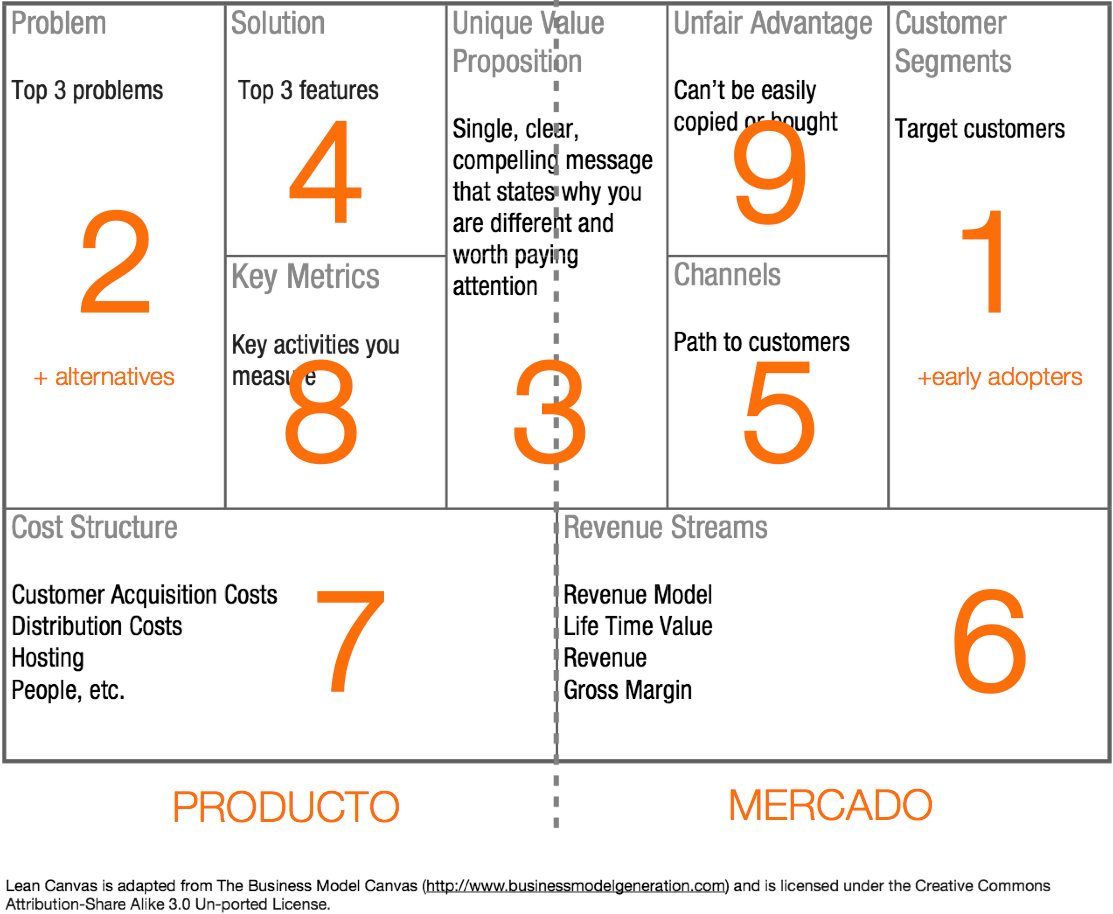
The Yuppie Handbook 1984 Chinese here. A Lean Canvas contains: 1. Problem: top 1-3 problems, existing alternatives 2. Customer Segment: identify user roles and early adopters 3. Unique Value Proposition: what is different that is worth paying attention? Target early adopters for crafting the correct message.
Have a high concept pitch. When # is low, qualitative >>quantitative feedback.
Solution: top 1-3 problems and their features 5. Channels: path to customers, start outbound (seek) but work on inbound (someway to get customers to you). Initial prospects ->branch out. Outbound - ads etc.
Remember that you should go after retention before referral. Revenue stream: high risk area. Test pricing early. Pricing is part of the product and determines your customers;) 7.
Cost structure: don't ask customers how much they are willing to pay. Relative to alternatives? Keep it simple, no tiered system to start with.
Key metrics: acquisition - how do users fine you? Activation - do users have a great 1st experience using your product? Retention - do users come back? Revenue - how do you make $?
Referral - do users tell others? Unfair advantage: something that cannot be easily bought or copied. Types of risk: Product risk: getting the product right Customer risk: building a path to customers Market risk: building a viable business Prioritize where to start. For this score all customer segments on the following and target the top ones (since they will most likely buy) customer pain level ease of reach price / gross margin market size technical feasibility Advice: seek external advice and APPLY it, don't just blindly FOLLOW it.
Test your plan with experiments. Formulate a falsifiable hypothesis, specific enough and can be proven wrong specific repeatable action ---->expected measurable action that way you know your hypothesis failed if it does not happen. Create accessible dashboards 3. Communicate learnings early and often - what we thought / expected? What happened? A problem solution fit is complete (almost!) when we (finish problem interviews) and 1.
Identify demographics of an early adopter 2. Have a must have problem 3.
Can define an MVP 4. Have a customer willing to pay $.
Every startup has it’s good and bad days. Question is, what to do, when you find that your initial idea is not quite as good as you expected it to be. Ash tries to answer this question by providing clean path to the success. By describing various aspects of running project he will show you issues that are particularly worth addressing.
I have to admit that Ash provides you with lots of valuable information regarding issues you will probably encounter during project. Generally, problem with this ki Every startup has it’s good and bad days. Question is, what to do, when you find that your initial idea is not quite as good as you expected it to be. Ash tries to answer this question by providing clean path to the success. By describing various aspects of running project he will show you issues that are particularly worth addressing. I have to admit that Ash provides you with lots of valuable information regarding issues you will probably encounter during project. Generally, problem with this kind of books is that evaluating provided solutions is very hard.
You can’t definitely tell that solution will work for you as well. Matlab Mac Os X Download Crack For Gta. In “Running Lean” you go through various aspects of running business with CloudFire project in a background – serving as example. Question is whether solutions good for CloudFire will be good for you? One thing I definitely found interesting in the book was Lean canvas – variation on a Business Model Canvas. Comparing to Business Model Canvas it better fits small projects. In fact, Lean canvas can be applied not only to a whole project but to a single task as well. This is quite convenient if you want to describe the tasks before proceeding with solving it.
In general, I think this book addresses some general issues but covers topic too much narrow. It is hard to tell how it fits into general concepts of running projects if you don’t have any other sources related to the topic at your bookshelf. If you're an internet entrepreneur, this is a book that should be found in your bag or on your desk, dog-eared and well worn. When they introduced the idea of a 'Lean Startup,' Eric Ries and Steve Blank challenged entrepreneurs and investors everywhere with a new Grand Theory about how startups work, what they do, and how they can be more successful. But there was little indication of how to translate those ideas into workable, real-world scenarios. Running Lean is the first book I've encountered If you're an internet entrepreneur, this is a book that should be found in your bag or on your desk, dog-eared and well worn.
When they introduced the idea of a 'Lean Startup,' Eric Ries and Steve Blank challenged entrepreneurs and investors everywhere with a new Grand Theory about how startups work, what they do, and how they can be more successful. But there was little indication of how to translate those ideas into workable, real-world scenarios. Running Lean is the first book I've encountered to offer specific answers and to share a step-by-step 'how to.' It's lucid, well reasoned, and most importantly--it's a record of these ideas as practiced. This isn't a book that espouses untested theory. That's not saying it's a complete answer, but it is a very thorough and compelling contribution to discovering a better set of answers. For some, this is a roadmap or guide book that will help you increase the odds of building a business that customers actually care about.
For others, it's a reference that can be used to help challenge your thinking, overcome mental obstacles, or simply offer the opportunity to relate with another human being who's been there before. Most of all, Running Lean is for anybody who's read 'Lean Startup' and thought to themselves, 'This is great, but now what?' This is a book on starting a new enterprise, which actually does not necessarily have to be a formal startup. I can see its lessons in my current role as a professor, who is not in the standard tenure track. In many ways, because I have to be regularly answering the question of what my position is it sometimes falls into this. This book is helping me frame how I present myself and propose new projects, in particular trying to establish a long-term stable position for myself.
In particular, the id This is a book on starting a new enterprise, which actually does not necessarily have to be a formal startup. I can see its lessons in my current role as a professor, who is not in the standard tenure track. In many ways, because I have to be regularly answering the question of what my position is it sometimes falls into this. This book is helping me frame how I present myself and propose new projects, in particular trying to establish a long-term stable position for myself. In particular, the ideas of presenting the minimum viable product and recognizing that in the initial stages you may have an idea, but it may take some iterations to determine what your market will be resonate greatly. From working I definitely see the pitfalls in the grand cathedral way of working. Now, when I'm simultaneously trying to reposition myself in my current organization as well as looking for other opportunities, this has helped sharpen my thinking and how I discuss my role with others.
I recommend it for anyone who is not in a position with a very well defined job category, not just people in startups. Recommended by Henri Shi from his VeloCity Campus 'Lean Business Model' workshop. I would label this book as a MUST READ for anyone trying to create a start-up or get started on a project.
The original 'Lean Startup' book by Eric Ries introduces the theories behind the Lean Methodologies. It's interesting, but it leaves you not knowing exactly where to start. This book, in contrast, is very detailed and practical. It shifts away from 'what to think,' towards 'what to do.' Examples: How to fill out a Recommended by Henri Shi from his VeloCity Campus 'Lean Business Model' workshop. I would label this book as a MUST READ for anyone trying to create a start-up or get started on a project.
The original 'Lean Startup' book by Eric Ries introduces the theories behind the Lean Methodologies. It's interesting, but it leaves you not knowing exactly where to start. This book, in contrast, is very detailed and practical. It shifts away from 'what to think,' towards 'what to do.' Examples: How to fill out a lean canvas (1. Start with problem. UVP.) The kinds of interviews a founder must do to validate his business.
Who to interview. What kind of questions to ask Sample emails to send to potential customers I found myself constantly referring back to this book as if it were a reference book while working on my own startup. Highly recommended.
What is running lean? It is a systematic process for iterating from plan A to a plan that works, before running out of resources. The essence of running lean can be distilled into three steps: 1. Document your plan by Lean canvas 2. Identify the riskiest part of your plan by researching, interviewing, MVP and etc. Systematically test your plan by iterating This book is for managers, developers and entrepreneurs, and all those who plan to start their own IT business. In that, the author shares his What is running lean?
It is a systematic process for iterating from plan A to a plan that works, before running out of resources. The essence of running lean can be distilled into three steps: 1.
Document your plan by Lean canvas 2. Identify the riskiest part of your plan by researching, interviewing, MVP and etc. Systematically test your plan by iterating This book is for managers, developers and entrepreneurs, and all those who plan to start their own IT business. In that, the author shares his previous experiences with readers and you read about interviewing, creating Lean canvas, service or product pricing, etc.
This book is too step by step and running a business in real world is not like this. I recommend reading the following books before reading this one: -The Lean Startup by Eric Ries -Business Model Generation by Alexander Osterwalder and Yves Pigneur. Running Lean is very well thought out..and tested! It talks through the thought process for creating a business.
Having worked at one of the early companies to follow what became the 'Lean' process: 'IMVU' it is very interesting to see the development and refinement of many of the concepts. Some of the key points that changed my mind and surprised me were: 1) Start by charging a price: If you don't charge a price up front, you will get a lot of users who sign up, and use the product, but are neve Running Lean is very well thought out..and tested! It talks through the thought process for creating a business.
Having worked at one of the early companies to follow what became the 'Lean' process: 'IMVU' it is very interesting to see the development and refinement of many of the concepts. Some of the key points that changed my mind and surprised me were: 1) Start by charging a price: If you don't charge a price up front, you will get a lot of users who sign up, and use the product, but are never likely to become real customers, and therefore will skew the feedback and learning you get from them.
2) Distinguish users from Customer (who pay): Users attend the meetings, read the proposal, download the app. But the customers are the ones who pay. Sometimes they are the same person, but you need to think through their experience and value propositions separately.
3) When you are starting out, feedback is the most important thing, so trying to scale on a paid or organic high volume channel is typically premature. Map out channels needed to scale, but start out with with direct selling, so that you can garner the feedback you need. 4)Do a lot of customer interviews [ 30-60 is Ash's recommendation]. A virtual assistant to help with scheduling.
Then make sure to write up summary right afterwards. 5) 'Your Product is not THE Product' from pg 6. I found this statement confusing, intriguing and then spot on. The technical product is one part of the overall solution. The overall solution and business strategy is THE product, and all the attendant parts of the business need to be given appropriate levels of consideration.
Reading this in order so that we are all on the same page before we create a lean canvas for eCraft International. Lean Canvas is a further development of Alex Osterwalder’s Business Model Canvas, which he describes in the book Business Model Generation. Lean Canvas helps deconstruct your business model into nine distinct subparts that are then systematically tested, in order of highest to lowest risk. Stage 1: Problem/Solution Fit Key question: Do I have a problem worth solving? Stage 2: Product/ Reading this in order so that we are all on the same page before we create a lean canvas for eCraft International.
Lean Canvas is a further development of Alex Osterwalder’s Business Model Canvas, which he describes in the book Business Model Generation. Lean Canvas helps deconstruct your business model into nine distinct subparts that are then systematically tested, in order of highest to lowest risk. Stage 1: Problem/Solution Fit Key question: Do I have a problem worth solving? Stage 2: Product/Market Fit Key question: Have I built something people want? Stage 3: Scale Key question: How do I accelerate growth?
Before product/market fit, the focus of the startup centers on learning and pivots. After product/market fit, the focus shifts toward growth and optimizations. Lean Canvas is a business model validation tool. It’s a companion tool to this book that helps you document your business model, measure progress, and communicate learning with your internal and external stakeholders. Good book that is build on the foundation from the Lean Startup methodology by Eric Ries, a synthesis of Customer Development, Agile Software Development methodologies, and Lean (as in the Toyota Production System) practices.
Or as Ash puts it, Running Lean is a systematic process for iterating from Plan A to a plan that works, before running out of resources. Probably one of the better trendy 'Lean' books out these days. Despite being drawn from blog content, it's fairly well edited he did an excellent job porting his posts and talks to book format. Stuff I liked: - The author is a technical founder, so he knows how the sausage is made. - To get your idea on paper, created a 'Lean Canvas' which is an adaptation of the Osterwalder Business Model Canvas. Maurya's canvas is much more down-to-earth and is a much better fit for any software start Probably one of the better trendy 'Lean' books out these days. Despite being drawn from blog content, it's fairly well edited he did an excellent job porting his posts and talks to book format.
Stuff I liked: - The author is a technical founder, so he knows how the sausage is made. - To get your idea on paper, created a 'Lean Canvas' which is an adaptation of the Osterwalder Business Model Canvas. Maurya's canvas is much more down-to-earth and is a much better fit for any software startup. Personally, I feel like it's much easier to reason through a business with his canvas than Osterwalder's. - He gives examples of 'outside the building' interviews with customers, and guides you through how to test your model's assumptions, ensuring that you're establishing falsifiable hypotheses. - Each key point is backed up with a Case study that relates back to his startup, Cloudfire. Not sure how much of that gets massaged to make his point but, eh, it does crystallize his message.
- There's not much fluff, which is pretty rare for a business book. - He liberally references other works and authors, providing ample attribution. If you want to explore something in more detail, he points you in the right direction.
A few nitpicks: - The 2nd Edition hardcover is pitched as covering a broader range outside of just SaaS startups. But most of his examples and anecdotes center around software startups. You could probably apply the concepts in the book outlined to other areas, but you're going to have to use your imagination for that - you're not getting your hand held. - While most of the technical advice given is solid (or at least not wrong), I take issue with a efw.
As a strategy to reduce work-in-progress, he recommends avoiding branching (page 188). IMO, the root cause of that problem is poor dev (or product) discipline and really shouldn't be fixed at the developer tool level (DVCS). Use branches wherever its best - they should not be used as constraints. He also recommends waiting to automate deployments (page 190). I'd qualify this and say its better to do it sooner than later IF you've got at least a passing familiarity with devops stuff. For newcomers I can understand taking it slow, but if it's not your first rodeo you can bang something out on a lazy Sunday that'll work fine and REALLY speed up your deployments. Automating things while your still 'lean' is going to be way easier.
Don't let any criticisms discourage you from reading this book. Anyone interested in doing a startup, who hasn't really done one before, will gain a lot of insight from reading this book. I picked up this book because having read the lean startup () I felt like I hadn't got much to proactively do to implement it's suggestions.
This book bills itself as the practical companion to the lean startup so I was deeply attracted to the premise. The book should be read chapter upon chapter as the ideas under discussion build towards the conclusion in a linear fashion. So effectively what you end up with is a step-by-step formula for emulating the aut I picked up this book because having read the lean startup () I felt like I hadn't got much to proactively do to implement it's suggestions.
This book bills itself as the practical companion to the lean startup so I was deeply attracted to the premise. The book should be read chapter upon chapter as the ideas under discussion build towards the conclusion in a linear fashion. So effectively what you end up with is a step-by-step formula for emulating the author's version of the lean startup concepts. This turned out to be a quite pleasant way of understanding how the activities interacted with each other.
It was clear as the book drew on where the author was going and the worked example metaphor felt natural and easy. The things I didn't like about the book followed three distinct lines. First, I didn't like the lack of reference back to lean startup. It was clear having read the lean startup where some of the ideas came from but at times I wanted to put this book down and go back to the source.
How did this fit with innovation accounting for instance? What stopped the authors chosen metrics being vanity metrics?
Effectively for a companion book to airily discuss the core book's premises with little reference back to the source meant it wasn't clear enough how closely the author felt he'd aligned to the lean startup's principles. The technology felt rather now, in that some of the services and techniques mentioned would likely not stand the test of time. There's a real difficulty here in that the how-to nature of the book is helped by the tool examples but in a couple of years time I wonder if for instance Optimizely would be my tool of choice for A/B testing.
Finally, and perhaps the thing that knocks a good star off the rating is the lack of critical appraisal of the successes and failures of the book. In his review () John Barton points to the survivor bias that is prevalent in the lean startup and this book doesn't feel much different.
It's not clear how the author failed at other efforts in order to come to this process, just the successful pattern. There's no reflection on where the lean startup doesn't apply well but sidebars pushing back common rejections. I'm pretty sure there are businesses that will fail following this method but they'll get little from this book about why. Overall, I'd read the book, but don't be surprised if you come out of it feeling like you're being sold to rather than coached on how to be successful. The thing about books like Running Lean is that they almost make me want to start a business of my own.
Unfortunately I lack the push to take the leap. Luckily, I am working in consumer service development, so I can actually make use of the learnings from this book in my current work. And what is even more fortunate, I can actually affect the way my team works. Running Lean is not actually a revelation, as I have been a fan of agile development for quite some time. Lean methods presented in this The thing about books like Running Lean is that they almost make me want to start a business of my own. Unfortunately I lack the push to take the leap. Luckily, I am working in consumer service development, so I can actually make use of the learnings from this book in my current work.
And what is even more fortunate, I can actually affect the way my team works. Running Lean is not actually a revelation, as I have been a fan of agile development for quite some time. Lean methods presented in this book have more to do with business development than product development, so combining these two help one reach both technical and commercial success. Running Lean is easy reading, and when applied properly, it can help you work smarter. My key takeaway from the book was the fact that product's value is not in the quantity of its features.
Rather, its the quality of few, carefully selected features. Doing the absolute least necessary might sound like a lazy way of doing business, but it is actually an extremely disciplined and demanding way of working. I was doing everything the wrong way. This book cleared me the startup panorama, introduced me to this world very quickly with a summary of some of the most popular and proven existing methods to face the challenges of starting a business, showed me the big don'ts (as secrecy) and led me straight to put the principles practice. Very practical and straight to the point.
There are not many good practical books like this for this topic. I would recommend this book to people who wants to start a busi I was doing everything the wrong way. This book cleared me the startup panorama, introduced me to this world very quickly with a summary of some of the most popular and proven existing methods to face the challenges of starting a business, showed me the big don'ts (as secrecy) and led me straight to put the principles practice. Very practical and straight to the point. There are not many good practical books like this for this topic.
I would recommend this book to people who wants to start a business now and don't want to spend time in much digging about theories. Just start doing, you can read about that later, doing is the best way to learn. Or also if you read a lot of books about entrepreneurship, startups or similar but you feel you need something more practical. It's for sure a great beginning. After this one I am queueing Business Model Generation, Lean Startup and The Four Steps to the Epiphany. I am also complementing with reading about Design Thinking, Tina Seelig books as inGenius, Clayton Christensen books as the innovators problem and solution or the Innovators DNA.
This is probably the most hollow and soulless thing I've ever been forced to read. After 30 pages of quotes about how good the book is and why it is going to be useful, Chapter 1 is a mishmash of quotes about how amazing entrepreneurs are at everything and defining buzzword terms and crediting other silicon valley Ted Talkers for inventing WORDS IN THE ENGLISH LANGUAGE. Chapter 2 is literally a case study in how writing this book fits his process for creating start-up companies. How the tab Ugh. This is probably the most hollow and soulless thing I've ever been forced to read. After 30 pages of quotes about how good the book is and why it is going to be useful, Chapter 1 is a mishmash of quotes about how amazing entrepreneurs are at everything and defining buzzword terms and crediting other silicon valley Ted Talkers for inventing WORDS IN THE ENGLISH LANGUAGE.
Chapter 2 is literally a case study in how writing this book fits his process for creating start-up companies. How the table of contents is the most important thing and hardest part of writing a book. How you basically just scam people into buying it and that is the only measure of its success. There's a lot of 'life is too short to.' In this 'book' which likely includes taking any kind of pleasure in actual literature.
I'm only up to Chapter 3 and I am thinking 'kill me now.' **Warning: this text may contain spoilers.** Link to Amazon Link to book: Steve Jobs Link to author: J.K.Rowling This is bold text. This is bold text This is italic text. This is italic text This text is underlined. This is underlined text This text is striked out. This is striked out text This is block quote This is block quote text This would be a new paragraph on GR.com but not a new pa **Warning: this text may contain spoilers.** Link to Amazon Link to book: Steve Jobs Link to author: J.K.Rowling This is bold text. This is bold text This is italic text.
This is italic text This text is underlined. This is underlined text This text is striked out. This is striked out text This is block quote This is block quote text This would be a new paragraph on GR.com but not a new paragraph on the device. This would be a new paragraph on GR.com but not a new paragraph on the device.
'Life's too short to build something nobody wants.' I have been an entrepreneur for more than a decade, and throughout that time I have been in search of a better, faster way for building successful products. Then I ran into early works on Customer Development and Lean Startup pioneered by Steve Blank and Eric Ries.
I joined in on the conversation and have been rigorously applying and testing these 'Life's too short to build something nobody wants.' I have been an entrepreneur for more than a decade, and throughout that time I have been in search of a better, faster way for building successful products. Then I ran into early works on Customer Development and Lean Startup pioneered by Steve Blank and Eric Ries. I joined in on the conversation and have been rigorously applying and testing these principles since then. I started sharing my learning on this blog, which then turned into a book, and subsequently into a series of products aimed at helping entrepreneurs raise their odds of success.
That is my mission and reason for being.