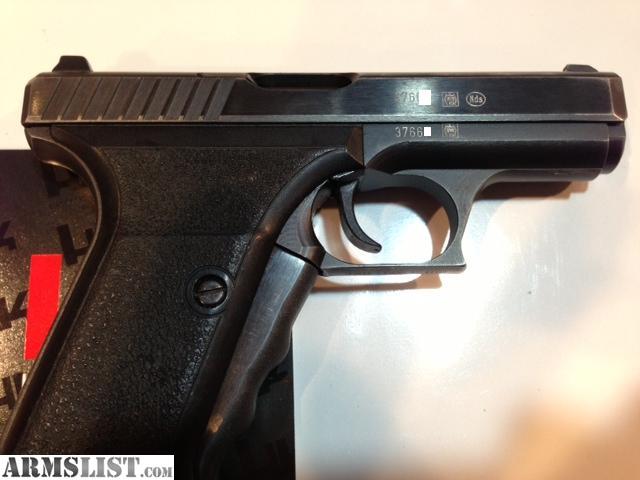
Hk P7 Serial Numbers
NEW DWM 1917 World War 1 Navy Luger, 9mm Para, serial number 1441. All original finish, all matching numbers including the correct matching magazine.
Features: Replace Briggs & Stratton 456 Replace Honda 16700-Z0J-003, 16700-ZL8-013 Replace Kawasaki Replace Kohler 24 393 04-S, 24 393 16-S Third party aftermarket accessory. Specifications: Type: vacuum pump 1/4' fuel inlet/outlet Compatible with: KOHLER CH17-CH25, CV17-CV25, CH730-CH740 and CV730-CV740 Briggs Stratton 28B702, 28B707, 28M707, 28N707, 28P777, 28Q777, 351442 and 351447 Package includes: 1 x Vacuum Fuel Pump 1 x Filter Brand Unbranded MPN Does not apply UPC Does not apply.
Given the current situation of numerous undifferentiated negative reports regarding the G 36 assault rifle manufactured by Heckler & Koch, as the result of press statements by the Ministry of Defence and Defence Minister Ursula von der Leyen, we feel obliged to issue the following statement: Unfortunately, the current statements by the German Armed Forces about the G 36 rifle were first brought to the attention of Heckler & Koch through enquiries from the press. Despite several offers by Heckler & Koch to involve the extensive know-how of the company accumulated over many years, the German Armed Forces have not involved Heckler & Koch in the investigation. Quite to the contrary, the German Armed Forces have not communicated with Heckler & Koch for nearly six months regarding unsupported allegations regarding accuracy issues with the G 36 at high temperatures. The G 36, is acknowledged worldwide as a, technologically superior assault rifle.
Unfortunately the German government did not afford an opportunity for Heckler & Koch to contribute correct information and facts that would have clarified and addressed any issues. The results being currently disseminated, diametrically contradict the extensive and elaborate testing conducted by Heckler & Koch, in view of emerging rumors regarding the accuracy of the weapon following prolonged firing or due to hot weather conditions, as well as those conducted by the Federal Office for Defence Technology and Procurement (BWB). These investigations have shown no relevant limitations in operational suitability if used correctly, nor are there any significant differences in these conditions in comparison with other assault rifles. No documents are available to Heckler & Koch regarding the current allegations, so it is not currently possible to provide an urgently required factual investigation into these reported results.
Therefore, Heckler & Koch can only state that the G 36 has consistently met, or exceeded any and all testing requirements specified by the German government, which includes an accuracy test, for all G 36’s delivered over the last 15 years and we have no reason to believe that the G 36 rifle is in any way an unsuitable assault rifle. Heckler & Koch would like to make the following comments with regard to the current negative reports on the G 36 rifle, in particular with regard to the current press statement by the Minister of Defence: We have been a reliable partner for the German Armed Forces for more than 50 years. The G 36 has been in use for nearly 20 years and has proven itself in more than 35 countries worldwide in numerous operations. We are dismayed by the statements issued during the past few days by the Ministry of Defence with regard to the G 36 rifle.
In particular, we sincerely regret that ministry did not seek discussions with Heckler & Koch prior to the last public statement with far-reaching consequences for our technical reputation. Heckler & Koch would like to clarify the following points: 1) All G 36 rifles of the German Armed Forces comply with the so-called “Technical Supply Specifications” as established by the German Armed Forces, which conclusively standardize and document the technical performance specifications of the G 36 rifle as part of the supply contract. 2) Our compliance with the stated requirements of these specifications is independently confirmed by the quality control centre of the German Armed Forces with the acceptance of each of the 178,000 G 36 rifles used by the soldiers of the German Armed Forces. To date, there have been no defects noted and therefore, any discussions regarding warranty for defects are neither factual, nor appropriate. 3) Press reports suggest that the German Armed Forces appear to have developed some new test criteria during the past 6 months, without consulting with, or including Heckler & Koch in the discussion of the new testing to be conducted or the results obtained. 4) To date, no office within the German Armed Forces have contacted, or even informed, Heckler & Koch, of any issues where the G 36 has failed to meet its specifications, although the company has offered an open dialog at all times. 5) Over the past few years, individual parties within the German Armed Forces have time and again claimed that new user scenarios had been developed from operations and it is in these scenarios that issues have been observed.
Should this be the case, then these altered use scenarios may themselves be creating issues. As there are presently a number of indicators that the use parameters applicable to our product have been changed, arbitrarily, it is suggested that this is the area where a mutual dialog could best serve our forces and allies. Heckler & Koch remains ready and willing to engage in these discussions to resolve once and for all these reports and concerns. 6) It is a fact that there is no standardized test method at NATO level, let alone an assessment criterion, for the accuracy of hand weapons: a) when overheated after repeated firing; b) at extremely high ambient temperatures; c) for extreme differences in ambient temperature or other climatic fluctuations; and d) during exposure to sun. 7) To the knowledge of Heckler & Koch, these NATO-wide undefined criteria are also so far unknown at a national level in the German Armed Forces. The only exception being in the spring of 2012, when the so-called “Realistic Combat Firing Cycle” (EBZ) was standardized for the first time, and in which the G 36 rifle, once again, was proven to meet, or exceed, the specified accuracy requirements.
8) Heckler & Koch is compelled to state that we were, at best, informed incompletely, always with delay, and as a rule not involved by the German Armed Forces in clarifying any of the recent issues claimed against the G 36 rifle, nor the investigations to substantiate them. The continued questioning of the technical suitability of the G 36 rifle stands in stark blatant contrast of the worldwide reality of G 36 operations over nearly 20 years. In the larger debate about the equipment of the German Armed Forces, the systematic proceedings against Heckler & Koch cannot be explained against this background, and we again request the right to have the opportunity to address any/all specific issues, by immediately conducting joint investigations, so that a fair and equitable conclusion can be reached. It is the right thing to do, for all concerned, and any continued reluctance to do so is not understood.
In response to recent media reports in Germany, commenting on HK’s ability to meet it‘s interest and other financial obligations, the company is pleased to make the following statement: The liquidity status and financial performance of H&K is not only stable, but improving. In addition to it‘s own substantial cash reserves, H&K has available to it an undrawn line of credit of 30 million Euro, which will remain available through 2017. Additionally, the order book shows a promising trend in new orders resulting from submitted proposals and new products. H&K‘s operations remain unchanged, with neither a reduction of staff, nor a reduction of capacity utilization. H&K is looking forward to continued improvements in operational and financial performance in 2015 and to continuing to design and manufacture the world’s best small arms for the defense and security agencies of NATO and its allies. Much as H&K may protest against this, there is considerable evidence that the rifle suffers from a polymer barrel bearing.
A gunsmith who requested to remain anonymous shared these images with TFB. This image of an HK 243 civilian variant of the G36 highlights the carry handle/sight attachment. Due to the contrasting finish, one can see that the sight mount is attached directly to the polymer receiver, itself attached to the rifle’s barrel. Under sustained fire, the polymer may deform and the sight may lose zero. If the Bundeswehr decides to replace the G36, it seems reasonable that they would purchase HK 416A5ss in replacement, as that rifle by the German government. That would be an unusual case of an AR-15 derivative replacing a second/third-generation 5.56mm rifle. So assuming you were aiming dead center on a 6” diameter steel plate, the POI would be off by a minimum of 3” in any direction.
This does seem fairly substantial for a gun “acknowledged worldwide as a, technologically superior assault rifle.” Since you own one, maybe you could do a video measuring the G36 POI shifts. Test cases could be; POI shift from sustained firing and significant outside temperature changes.
I think this would make a great TFB article considering how often this topic has popped up. I wasn’t implying they were blow back operated. Each round was fired from a locked breach. A rather complex arrangement to get the rounds out so fast that they sounded like one shot. I’ve never fired a machinegun that was so fast. In shooting the MP5 at night, having a patrol car spot light on the target I was always surprised to see the cluster of copper bullets so close together, that it didn’t seem like they were sensed as being much slower.
Instead of a stream of bullets they looked like a cluster of copper plated buck shot. The only machinegun I used that was straight blow back was the M1A1 Thompson SMG. It ran pretty slow. Everyone was complaining that it climbed off target. I found once the first 2 shots were out, you could control the gun like a water hose.
Except for the M1919 and M60 belt guns most of my shooting was with M16A1 and the MP5. I loved the MP5, using it for 12 or s0 years as my primary shoulder weapon. If we’re going to get very pedantic about it, all the HK family of firearms (as well as Kiraly-type, P7-type gas, etc) are retarded blowback. “Delayed” means something else that is rarely seen in firearms (but relatively common in autocannons). A breakdown of the terms: “Retarded blowback” – The weapon is never locked, but the mechanism has to act against some sort of disadvantage before unimpeded blowback operation can commence. Examples: H&K G3, H&K VP7, FAMAS. “Delayed blowback” – The breech is locked upon firing, but is unlocked through some mechanism (note the overlap with short-recoil operation here).
Operating power is provided by blowback gases from the chamber. This differs from gas operation and recoil operation in the source of the force used to complete the cycle.
Perceptive readers will note that this occupies a kind of gradient with gas- and -recoil operation. Examples: I believe the primer-actuated early Garand designs fall into this category. The problem with the FAMAS (as I understand it) is that as blowback (be it straight, retarded or delayed) results in a very violent ejection cycle causing the brass to be deformed hence the need for steel cases. As for the HK33 not working well with 5.56mm I have no idea where I first heard this but I seem to recall it had somthing to do with the size of the bolt face or some such.
Of course I might be delusional and making this all up. But still the failure of the G41 was I think mostly cost. Whilst the G33 was more successful it never achieved the level of success as the G3 again I think its cost. By the time the market went to 5.56mm M16s were cheap as chips and plenty of nations simple opted to copy the AR18 which could in theory be made cheaper than the G33. A very large part of the militarily hot world today is “sandbox.” As for the relevant testing to duplicate the problem, I believe it is this: (Do this or careful simulate this->) Patrol for a few hours on a very hot sunny day.
Engage enemy, firing even just five or six magazines, at least some of them on full auto, in an already very hot chamber/barrel. Disengage and patrol for a few more hours.
THEN see how far south your zero has gone, as your barrel/trunnion’s cradle has melted, shifted, and then re-solidifiedall unnoticed by the guy with the rifle until it’s too late. I believe TFB’s (and Andrew’s) explanation of the long-term failure of HK to export its attractive weapons contains a blaring error.
The article states (and attributes back to Chris Kyle) the following: “First of all, German export laws are just as if not more complex than our import laws. You see, the German government effectively owns the patents and export rights of all firearms made in Germany, and it takes years to get approval for the exportation of even military rifle designs to H&K USA!” This is simply wrong. The German government does not effectively own the patents and export rights of “all firearms made in Germany” but rather only and specifically for firearms which have been sold to the German military. It is THAT bit from which H&K has been vociferously seeking relief for years.
This isn’t my field of law, but I believe HK has recently received hope of such relief. They should have pursued the matter years ago, based on a “semi-auto only” exemption. I personally think the problems run deeper: In working up the HK45 pistol HK had tremendous sources of solid advice. They choose to ignore much of it.
Specifically they ignored Vicker’s advice on the trigger design (and grip). Who in the civilian or police world wants a pistol with a second-rate trigger? Sure, some devotees will buy it and make it work, but mass sales were hindered. I personally would have purchased an HK45 if there was a model whose trigger package (total feel and function) suited me. Chrome-lining and case hardness specs were also major factors. A reasonable short version of the story is that the DoD accepted manufacturer claims that the AR-15 was an “off-the-shelf” weapons system that was good to go.
In reality, the AR-15 had not yet had a proper development cycle, and a totally new rifle and caliber were fielded to Vietnam without what I would consider prudent testing. With the M16A2, the AR-15 finally reached a proper level of maturity, but frankly that should have happened much earlier. In the firefight in Afghanistan that spurred the controversy, G36s were fired back to back nonstop on auto, even the G3s were malfunctioning due to the sheer ROF they were subjected to (about 11 magazines back to back in a very short time frame).
It seems like a lack of training and discipline on the part of the German Army in addition to not asking HK fix the rifle after finding melted polymer on their combat rifles. If their going treat their rifles like that they may as well buy M27s, along with more MG4s and HK121s.
The G36 receiver is created by placing a steel trunnion inside of a mold and then injecting glass filled nylon (or some variation of it) around the trunnion. Its actually a very clever and cheap way of making a rifle much like stamped sheet metal was decades ago.
Obviously there will be issues with the trunnion expanding inside the plastic receiver under sustained fire. That said I find it hard to believe that sitting outside in the sun for several hours would cause significant Point Of Impact shift. But I have never owned or fired a G36, so what do I know.
Mexican Police Use G36 carbines, the Mexican Armed forces moved to a indigenous weapon called the FX-05 “Xiuhcoatl” which is heavily influenced by G36 especially early models which caused some claims of copy right infringement. But HK them selves investigated this and gave the Mexican’s the Okay Speaking of which I think the recever of the FX-05 is also injection molded thermo plastics so it might have the same issue. XM8 was a derivative of the G36C and shared the same bolt and gas system design but it’s receiver assembly broke down more like a M4’s then a G36 It also likely would have had the same Trunnion. “XM8 was a derivative of the G36C and shared the same bolt and gas system design but it’s receiver assembly broke down more like a M4’s then a G36 It also likely would have had the same Trunnion.” When I was younger I bought into all the hype about the XM8 being a lighter more “reliable” platform as well as with all the piston driven stuff. Older and more mature I am happy the US military did not adopt the XM8 if it indeed had the same barrel trunnion design. Also with the M4 using early KAC RIS, this gave the M16/M4 platform greater user options of modularity and customization something the XM8 didn’t look like it would have. I believe that no matter what boat you choose to float in, everything out there now does essentially the same thing but with different mechanics.
So to me, trying to beat your chest and drum in a vain attempt to prove one is leaps and bounds superior over the other is very narrow minded and moot. What I got from their press release was, they have it designed perfectly to all German technical specifications, but that a “new” test or tests was conducted on the rifle that was never speced to them in the original design (high heat), which they can’t address because they were not part of the test.
It leaves enough room in there to weasel out by saying “we designed it to spec, this wasn’t in spec, it’s the Bundeswehr’s fault for not specing it to begin with.” At least that is how I am reading it. And that is exactly where german ministry of defence failed miserably the last decades, at least according to an article in last weeks german newsmagazine DER SPIEGEL: constantly being outwitted by the contractors, so no or no substantial compensation is possible if a program fails (miserably).
And besides: of course H&K follows the “we followed specs”-line. So it’s not there fault, when specs are wrong – they still made the perfect product for – imperfect – specs. And I won’t go to the German tradition of “we do what we’re told” •.
Wel they designed a cheap, lightweight and accurate rifle that should be used in single schot mode for the bundeswehr. Becaus thats was what was ordert. They deliverd true to specs.
But over the pas 25 years the role of the germany army changed en they saw some pretty heavy firefights in Afganistan. Here the found out tha that the rifle had these accuracy problems.
So now they call it a bad rifle. True it doenst do the job it needs to do these days. But back when they orderd it id did what it was supposed to do. Encasing the trunion in polymal wasnt a verry good idea. But it was cheap (remember the bundeswehr wanted a cheap rifle) and did the trick if the rifle was fired in singel shot mode in regular german weather •.
Russians still use wood because it does not freeze hands in artic conditions. It also is more comfortable in hot desert conditions.
The polymer buttstock of the M16 was however ideal for vietnam as it was virtually indestructible. The Swiss Sphinx SDP only has the grip made of polymer. The Walther CCP has the slide riding with a piston, completely floating over the polymer. I always felt funny about direct slide to polymer interactions, and in this case a hot barrel like this does not seem wise. Wood would be indeed a better insulator.
Nathaniel, I called this awhile ago when the Germans stopped even buying spares for the g36. But really this shouldn’t be a surprise to anyone with even a basic understanding of materials science. I mean it’s why they put expansion joints in friggin’ bridge decks for the love of god! Stuff like this and HK’s response to it is why I consider the products they are marketing now, and working to complete and bring to market, a total joke. Come on guys, is this really a surprise? They put two materials with wildly different behaviors under the thermal load EVERY RIFLE should be designed to work under in direct contact with each other in a way that each depends on the other for proper alignment and then act like its a ****Ing surprise when this happens What you thought changing the body style from XM8 Which also reportedly had the same damn problem would make it magically change?
The meme shouldn’t be: HK because you suck and we hate you to HK you only want our products because you can’t have them •. I lost my faith in German engineers when I had to work on a Mercedes SemiTractor engine- utterly rediculous garbage. Then a Sprinter pulled in, and that’s even worse. They seem to think that the more complicated and fragile something is, the better it must be. Their suprise that their rifle should work even when the sun is shining reminds me of “Deal of the Century”, when the drone malfunctions after being washed.
“Have you ever heard of rain?” Oh yeah, H&K, people will expect your rifle to function in the rain, too. Excellent comparison. I never understood why so many people think Germans make great anything. Epson Lq 500 Windows 8.
Thank God Hitler’s people couldn’t stick with known functioning implements of war. His crew wasted so much on bigger and more complex designs that they failed to make more things that worked. The “Great Tiger Tank” that lost out to field mice, produced in the hundreds while Russian T34’s were coming out in the tens of thousands.
So, simple they drove out of the factory into battle. Super artillery moved by trains and having crews of hundreds, when had they made more 8.8cm cannons they might have won.
Thank God the Germans were so dumb. You forget about the advantage in ressource availability, which the UdSSR and the US had. Both, US and UdSSR had oil, iron ore and any other materials, their war machinery needed. Germany had very little iron ore, next to no oil and the transfer of these ressources from the occupied territories to the production centers (most of them were located in Germany) was getting more difficult when the war progressed, since the US and the Brits not only bombed innocent civilians, but also the infrastructure. But you are right, there were some severe miscalculations made in the leading ranks.
The first jet fighter was already flying around August 1939, even BEFORE WW2 started. It was the He 178.
Imagine the Luftwaffe had dropped propeller driven planes and switched entirely to jet planes from the first days of the war. The Battle of Britain would definitely have had a different outcome and so maybe WW2. Nevertheless, it came differently. But fact is, that, although Germany had such a sh*tty govt., which made many many mistakes in that time, it withstood the British Empire, the USA and the UdSSR for around 4-6 years, which I think, is pretty impressive. Germany’s governments are exceptionally stupid. No sane nation would start a war knowing they need raw materials in other nations to build basic arms. Biting off more than they can chew has been a historical German failure.
Japan did it as well. Axis nations all needed raw materials of others to conduct war against others. Japan and Germany were particularly racist. Had they wanted to improve the lives of the citizens, every thing they needed for those people could have been purchased. Since all of them desired too much for the wrong reasons it led to war. Killing innocent lives by the allies, made sense. Killing enough of the enemy and infrastructure was needed.
Too bad for the people, even the individual soldiers, with no desire to kill innocent people, but being forced at gun point to kill, made them fair game. Like WW1 a spat between the royal cousins resulted in millions dead, all for no good reason.
We’ll see it in the Islamic world, as the nuts will do so much damage, that they will bring about WW3. I fear you think history from its end, studded with a huge amount of false information and therefore I forgive you your wrong historical interpretation out of unknowing. Also TFB is not a platform for historical or political discussion, so the last thing I say about this topic is: Germany’s governments were not more or less EXCEPTIONALLY stupid, than any other unsustainable govt.
Like the US-govts since 1913, when they turned themselfes in to a privat bank syndicate called the “FED”. Now look where they are, the “great” US and A: approximately 50 million people on food stamps and a national debt of almost 18 trillions USD. If that’s not exceptionally stupid.
Germany had too many gun designs they tried to put into service at the wrong time. It is why they never issued a truly functional semi-auto rifle in reasonable numbers. Too many different paths which denied the German soldiers good gear. Too much spent on weapons of limited usefulness.
The two World Wars were fought for the wrong reason and with a hodgepodge of weapons. Neither Japan nor Germany entered the war with adequate supplies of what was needed. The desire for materials, so they could conduct wars, was why the Axis lost. Japan had been at war for 10 years before Pearl Harbor, seizing territory with those materials needed for war making.
Germany did the same, seize land with raw materials and factories, so they could seize more land. Needing to make weapons for war drove the war. Neither nation needed to go to war. Had they simply wanted to improve their nations they should have simply bought what was needed for industry and agriculture. That need for weapons that were not needed had they been thinking clearer. That’s not an issue to put the trunnion or the barrel in any material till it fulfill all requirements.
Extensive tests has been made on both the G36 and XM8 family without making these rifles unsuited for combat. We heard a lot of accuracy issues after heavy fire because of barrel bending due to a lack of stabilization of the steel. That “may” be the case here.
That also may be due to a change of the polymer’s properties due to aging. In any case, we should wait for a rigorous test before making any assumption. Great question, nan. My understanding here is that two things are occurring that cause problems in the G36: First, the polymer is expanding during heating and cooling, and the only link between the barrel and sight is through the polymer receiver. The second is the permanent deformation of the polymer receiver under more extreme thermal loads. Weaver’s solution of using a ceramic “firewall” is certainly an interesting one, but it does not solve the issue Alex reports of the polymer expanding even in direct sunlight. I do not think the existing G36 can be full fixed via anything short of an extensive hack-and-weld overhaul.
To fix the design, the simplest method would be to change the materials used for the receiver. Most obviously, a switch to aluminum would eliminate this issue, though it would almost triple the weight of the receiver. The original receiver shape could probably be retained through forging. This would increase cost and weight, which obviously encourage looking for other solutions.
One might be to select or develop a polymer with a low coefficient of thermal expansion and a high melting point (I am not certain of the degree to which high performance thermoplastics like PPS* are suitable for this application, it really is a question for a polymer engineer). Another might be to change the architecture of the receiver to accommodate a cantilever sight mount that would be independent of the polymer receiver. The coefficient of thermal expansion is 2.5×10^-5, which is very low for a polymer, but still about twice that of aluminum. An aluminum receiver and M4-style stock would be the first modifications Id recommend (no need for a side folder and the current stock is HORRIBLE). And the removal of the carrying handle and modification of the charging handle into a non-reciprocating one.
Or, more drastically, sealing off the bolt carrier completely. Another option is to have an extended aluminum or alloy “skeleton” that holds the trunnion. You would still have heat affecting the polymer, but the trunnion would be held secure by a material that is less profoundly affected by heat. This, of course, can also secure the optics rail. But at what cost?
It would probably be heavier and expensive. It would definitely be more expensive than a M4. The Issue is the mating of a Polymer upper to a steel barrel being used in a Automatic weapon system.the best Correction without tossing the weapon would likely be to replace the polymer Upper Receiver shell with a identical Upper made of a light weigh aluminum alloy only the barrel and Trunnion needing to be installed. Because of the G36 Design is modular every other existing part of the G36 could then be retained, including hand guard, stock, mag well, pistol grip with trigger group, Stock, bolt, and sight bridge, gas system and more. This could be Bad news/Good news/Bad news with a possible silver lining. The first bad news is for the German military that may end up scrapping a flawed G36 into parts kits. Good news for North American and other shooters: Potential cheap parts kits for a highly desired but unavailable rifle!
Bad news for those same shooters: It would still be a flawed design. Possible silver lining: An overnight cottage industry of US made billet aluminum receivers Which should have been the material of choice for the original design. I’ve gotten in many heated debates with people that thought the panther and tiger were the most revolutionary tanks ever conceived.
That, by golly, without them, we would still be fighting wars in in Chaffe light tanks according to them. The only good thing about either one IMO, were their guns and crew layout, which was what made them fearsome killing machines.
The skill of their crews especially. Their chassis were absolutely horrible. Lack of availability only served to drive a stake into the Wehrmacht’s total combat power, especially since the US and Soviet Union produced utterly ridiculous quantities of tanks. IIRC, even the Panzer IV, which was far simpler and reliable than the V and VI, was also complex in its own way.
Apparently even when compared to Shermans and T34s. How this is a news? I mean, when German army joined US in Afghanistan over 10 years ago, their SF – KSK – already reported problems with G36 melting.
That was when they’ve ordered new variants of optic platform, and aluminum rail forends from KAC. From what I remember, officials state of mind was something like “yeah, SF who are actually fighting, have problems but ATM we don’t have enough cash to replace every rifle, and because grunts, who sit in barracks, are fine with them, we are fine too”. Fast forward to 2013, when it seems not only KSK is involved in fighting, and Bundeswehr panicks because “our guns are melting”! And HuK answers with statement such pricky as only they would do. BTW for American readers: some of You are wildly amazed “how come rifle is 20 years in use and nobody noticed”? Geoffrey Bawa The Complete Works Pdf Files. Well, this is the same story with M16 and M4. Weapon works at a range and passes every test.
But when in the field, under extreme weather conditions, and without proper maintenance, all the problems came out at once. For half of it’s life G36 was used mainly in barracks or at proving grounds in Germany, where weather is cold, and rules are strict. The same with M4 – great weapon in theory, while in Afghanistan and Iraq problems started to arose. But there’s already a cure: HK416, combining best of both G36 and M4.
So maybe HuK’s high self-esteem have some rational basis. It’s a really difficult problem as both sides have their own story. Either H&K or the German Army is not being honest about the performance of the rifles.
If the design of the H&K G36 is indeed faulty in that manner, it would certainly hurt H&K’s company image and the German army may not even give them a chance to make changes to the design to fix the problem or even buy rifles from them anymore which might mean the German Army will have to look for other manufacturers to supply them with weapons. There are a few things that I didn’t see in the pictures. I believe that yes it is possible to get the barrel so hot that yes you can melt the polymer, shooting hundreds of rounds through the rifle without letting it cool at all you could get the barrel red hot. In a fire fight in Vietnam with soldiers carrying the M60 would sometimes change out barrels during the battle and needed special gloves to do it, because of the barrel would get so hot. I just see a rifle that got hot in the pictures, not how it got hot.
Second I didn’t see a bunch of rifles all showing the same problem. I guess my point is that H&King should be allowed to join the investigation if only to show them how the rifles were tested. Soliders in a combat zone must relies on there rifles and they must work, but no rifle can withstand fully automatic rate of Fire indefinitely. Personally I think that it was stupid to put polymer around the barrel of a combat weapon, how could you not see this coming?
I own an USP and I love it, it has never failed to cycle in the 22 years I’ve owned it. I have a feeling that H&K will fix their defective rifles, their just mad that they were left out of the loop and not allowed to correct this problem before the press was told.